

- Advisor: Shree K. Nayar
- Published at: Columbia University, 2024.
- Link: Columbia Academic Commons

Background & Research Approach
I hold a Ph.D. in Computer Science from Columbia University, advised by Shree K. Nayar. My research connects computational imaging, audio, and multimodal generation with a broader question: how can intelligent systems use the structure of physical signals and human behavior to perceive, generate, and interact in the real world?
Two principles guide my work: ground learning in domain knowledge, and build around human behavior, participation, and intent. I combine classical methods, physical models, and explicit constraints with deep learning, using each where it contributes most. Acoustic priors, geometric relationships, and motion structure help shape both the inference problem and the architecture of a solution.
I pursue these ideas through end-to-end research and system development, from problem formulation and data preparation to modeling, evaluation, and deployment. My work with Snap Research includes live interactive experiences such as Billie Eilish events, while my speech-denoising research contributed to a granted US patent. Real-time performance, personalization, and usability are part of the research problem: they determine whether a method can become a useful interactive system.
Selected Research Areas
In computational imaging, my work on Trapping Light uses mirror geometry and time-of-flight measurements to reconstruct occluded surfaces. It connects optical design with geometric inversion and hardware validation, establishing a foundation in recovering information through the physics of sensing.
In speech enhancement, I combine signal structure with learned inference. Listening to Sounds of Silence draws on natural pauses in human speech to estimate changing background noise, outperforming tested audio-only and audio-visual baselines using audio alone and generalizing to languages unseen during training. Personalized Dereverberation combines a measured acoustic prior, feature-based Wiener deconvolution, and GAN-based refinement; a one-time recording procedure lets users participate in adapting the model to their voice and environment. These projects connect human behavior and participation with knowledge-guided modeling.
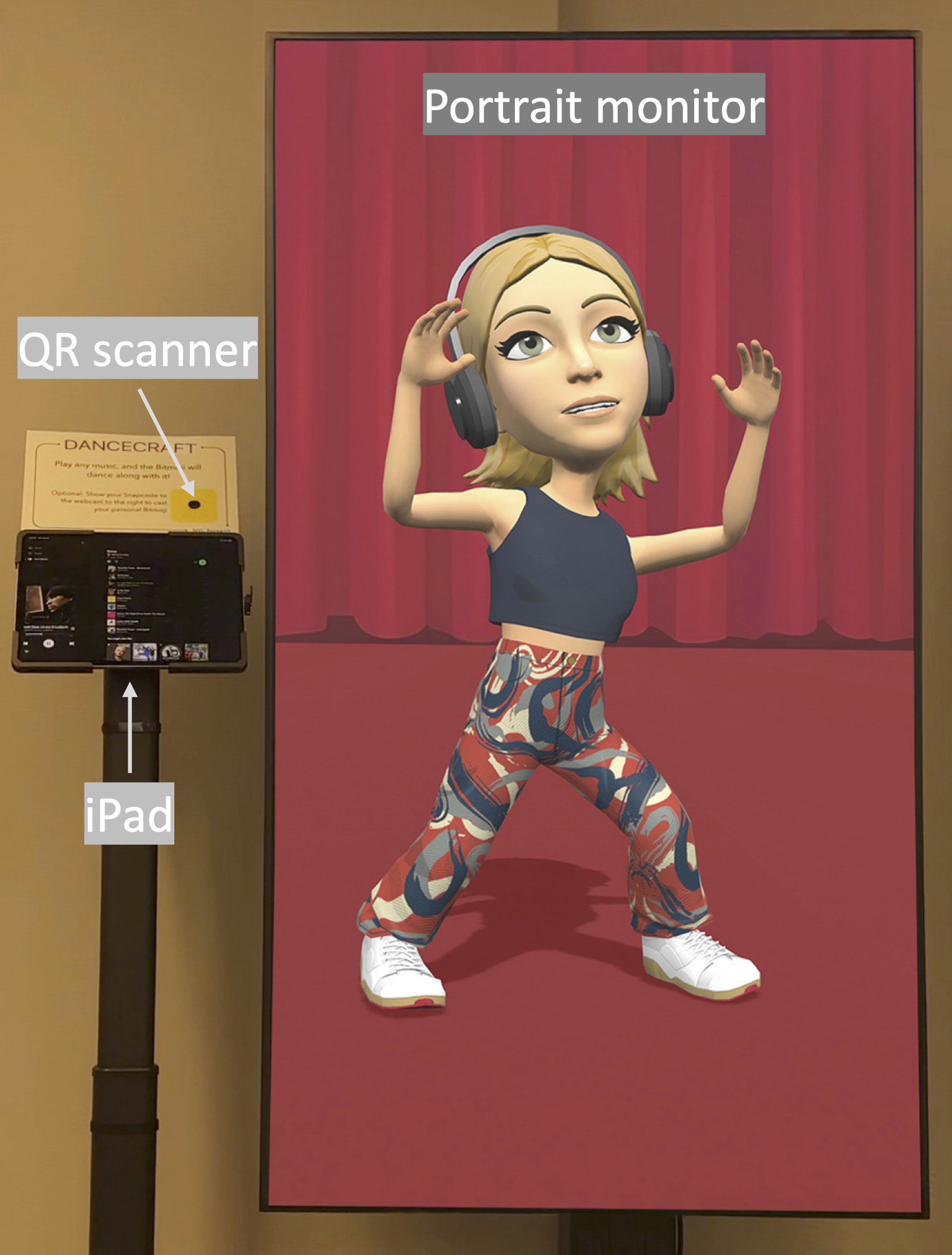
In multimodal generation and interaction, I led the development of DanceCraft, which turns live music into continuous 3D dance motion. Human motion-capture data, graph-based motion selection, and neural transitions work together to balance coherence and diversity, while live input and personalized avatars connect generation to human performance and creative intent. Across my projects, I evaluate methods through objective measurements, perceptual studies, and working systems.
Research Vision
My long-term goal is to connect multimodal perception, knowledge-guided generation, and human-guided interaction. I want to build systems that recover meaningful structure from physical signals, use that understanding to generate coherent behavior, and respond to people in real time. This direction grows from my work in imaging, speech, and motion generation toward a closer relationship between sensing the world and interacting within it.
One part of this vision is wave-based intelligence: combining visual perception with complementary sensing channels to understand aspects of the physical world that images alone may not reveal. My current experience is grounded in computational imaging and audio; I see opportunities to extend these methods to vibration, ultrasound, and RF sensing, where different signal-material interactions may provide information about hidden structure, motion, and physical state.
Alongside richer perception, I am interested in controllable multimodal generation that incorporates domain constraints and human guidance. Interactive creative tools provide a concrete setting for this work; embodied systems offer a longer-term direction for connecting environmental understanding, action generation, and human collaboration. Across these settings, my aim is to make knowledge and human participation integral to how intelligent systems learn and operate.
Ground learning in knowledge. Shape intelligence around people.
Connecting perception, generation, and interactionMy Research Interests
Computational Imaging
Wave-Based Intelligence
Multimodal Perception
Knowledge-Guided Learning
Cross-Modal Generation
Controllable Generation
Human-AI Interaction
Real-Time ML Systems
Speech Enhancement
Education
Doctor of Philosophy in Computer Science
2018 - 2024
 Columbia University, New York, NY
Master of Science in Computer Science
2015 - 2017
Columbia University, New York, NY
Bachelor of Science in Computer Science
2010 - 2014
 University of Illinois at Urbana-Champaign, Champaign, IL
Industry / Research Experience
Research Scientist (Joint Collaboration)
2023 - 2025
 Snap Inc. (Snap Research, Computational Imaging), New York, NY
Columbia University, New York, NY
- Led the research, development, and delivery of DanceCraft, a controllable, real-time multimodal generation system connecting live music with continuous 3D dance. Took responsibility across modeling, data, interaction, and system integration. Coordinated tasks for a contract engineer and personally handled core implementation, hardware setup, and company demonstrations.
- Designed a hybrid generative pipeline: live music descriptors (tempo/energy/beat) → graph-based motion selection → Transformer-based motion in-betweening. Randomized transitions allow different performances of the same music. Separating sequence-level structure from learned local transitions supports continuous, long-horizon generation while balancing motion coherence and diversity.
- Developed the system for deployment at Snap, from hardware demonstrations to large-scale interactive experiences, including Billie Eilish events. Continued the Snap Research–Columbia collaboration through 2025, supporting deployment and productization following completion of my Ph.D. in 2024.
- Evaluated dance quality and interaction with 32 participants. On 7-point scales, mean dance-realism ratings were 6.03 vs. 2.78 for Bailando++; responsiveness ratings were 6.19 vs. 1.50 in the study's live-interaction versus offline-generation workflows. These results connect model quality with the value of immediate, personalized interaction. Section 6.2, Figures 7–8
- Published at ACM MOCO 2024.
Research Scientist (Joint Collaboration)
2021 - 2023
Snap Inc. (Snap Research, Computational Imaging), New York, NY
Columbia University, New York, NY
- Led Personalized Dereverberation as first author, from problem formulation and protocol design through data collection, modeling, and evaluation, as part of a Snap Research audio R&D effort.
- Addressed the gap between non-blind methods that depend on an accurate RIR and blind learned methods with limited generalization across acoustic environments, using environment- and speaker-specific personalization to combine measured acoustic structure with learned adaptation.
- Designed a knowledge-guided hybrid model combining feature-based Wiener deconvolution with neural refinement in a GAN framework. The measured acoustic prior structures the inverse problem, while learned features and refinement compensate for spatial mismatch and residual artifacts.
- Assessed listening quality through paired preference tests; the proposed method was preferred over HiFi-GAN in 93% of comparisons in the reported study. Figure 3
- Presented at INTERSPEECH 2023.
Ph.D. Researcher
2019 - 2022
 SoftBank Group Corp., Tokyo, Japan
Columbia University — Computer Graphics Group, New York, NY
- Led the Columbia-side research in an industry–academic collaboration with SoftBank, from problem formulation and model design to experimental validation, as first author of Listening to Sounds of Silence.
- Designed a behavior-informed speech denoising framework, translating a natural property of human speech into a modeling advantage. Silent intervals between words and sentences expose changing background noise, providing structure for noise estimation and speech recovery.
- Outperformed Adobe Audition CC 2020's noise reduction and the tested audio-only and audio-visual baselines using audio alone on the paper's DEMAND/AudioSet evaluations. Audition was evaluated with default settings; real-world comparisons also showed stronger noise suppression in challenging everyday recordings. Section 4.1–4.2, Figures 5–6, and Section 4.6
- Named inventor on granted US Patent 11,894,012, Neural-network-based approach for speech denoising, arising from this research. Patent
- Presented at NeurIPS 2020.
- Follow-up: Mentored graduate researchers in extending an established research result into a real-time streaming system, building on my prior denoising work. Provided ongoing research and technical mentorship on a dynamic sliding-window strategy addressing accumulating delay under fluctuating compute availability; published at ICASSP 2022.
M.S./Ph.D. Researcher
2017 - 2019
Columbia University — Imaging and Vision Laboratory (CAVE), New York, NY
- Led the end-to-end design of a computational imaging system, connecting optical design, physical modeling, and computational reconstruction through joint sensing-hardware and algorithm development.
- Combined a planar-mirror light trap, pulsed time-of-flight sensing, and first-return measurements to recover reflected ray paths from known mirror geometry, enabling single-scan, surround 3D capture without solving a correspondence problem across virtual views.
- Demonstrated more than 99.9% simulated light-ray surface coverage in the studied configurations; pyramid-trap simulations achieved over 99% coverage across diverse objects with approximately three reflections. Paper
- Built and calibrated a working hardware prototype (pulsed ToF + planar mirrors) and developed geometric inversion methods to reconstruct reflected ray paths and recover occluded surfaces.
- Presented at CVPR 2018.
Student Researcher
2016 - 2016
Columbia University, New York, NY
- Developed visual detection methods for news-video analysis in C++/OpenCV, combining face detection, color histograms, and adaptive background analysis to identify anchor frames.
- Co-authored research on news-event understanding by mining latent factors from multimodal (video + text) tensors, published at iV&L-MM 2016. Publication
Teaching Experience
Teaching Assistant
2016 - 2024
Columbia University, New York, NY
- Served as a teaching assistant for First Principles in Computer Vision, taught by Shree K. Nayar, across multiple semesters, taking a lead role in coordinating TA work and organizing grading sessions, as well as proctoring exams.
- Collaborated on rebuilding the course assignment suite from the ground up in Python, replacing MATLAB-based assignments that had been used for over a decade. Improved assignment grading systems and contributed to academic integrity and anti-cheating measures.
Earlier Industry Experience
Software Engineer
2014 - 2015
 Foxit Software, Fremont, CA
- Designed and implemented a PDF Reader SDK demo and an integrated all-in-one SDK for enterprise clients.
Business Analyst Co-op
2013 - 2013
 Monsanto Company, St. Louis, MO
- Developed a unified data-source pipeline for the Seed Processing Manager, streamlining repackaging and distribution workflows.
Software Engineer Intern
2012 - 2012
Foxit Software, Fremont, CA
- Led a cross-site effort to design and deploy DocuSign integration testing, adopted by QA teams in the US and China; collaborated on testing strategies for multi-platform PDF readers.
- Optimized Android PDF performance with Java/C++ algorithms and unified multiple demos into a shared framework, standardizing code conventions and establishing an internal demo standard for client presentations.
Programming Languages
Python JavaScript C# Java C/C++ HTML/CSS MATLAB LaTeX
ML Frameworks & Libraries
PyTorch TensorFlow Keras torchaudio librosa SciPy scikit-learn Matplotlib pandas OpenCV
Model Architectures
GANs Autoregressive models VAE / VQ-VAE Transformers CNNs RNNs / LSTMs U-Net
Multimodal & Generative Methods
Multimodal learning Audio-to-motion generation Motion in-betweening Cross-modal alignment Knowledge-guided modeling Human-guided interaction Hybrid generative systems
Real-Time Systems & Engineering
Real-time inference Streaming pipelines Personalization Hardware prototyping Time-of-flight / 3D sensing Motion-capture data processing Audio feature extraction System integration Docker
Research & Evaluation
Mathematical modeling Inverse problems Speech enhancement Signal processing Experimental design Ablation studies Perceptual evaluation User studies
- All Projects
- Speech
- Animation
- Vision
- Real-time
- Interactive
DanceCraft
Real-time, controllable music-to-motion generation through graph-based motion selection and neural transitions.

Personalized Dereverberation
Knowledge-guided dereverberation with one-time personalization, Wiener deconvolution, and GAN-based refinement.

Dynamic Sliding Window
Dynamic sliding-window streaming denoising with low, stable latency under tested fluctuations in compute availability.
Harmonizing Audio and Human Interaction: Enhancement, Analysis, and Application of Audio Signals via Machine Learning Approaches
Ph.D. Dissertation
DanceCraft: A Music-Reactive Real-time Dance Improv System
Conference Paper
- Authors: Ruilin Xu, Vu An Tran, Shree K. Nayar, and Gurunandan Krishnan
- Published at: In Proceedings of the 9th International Conference on Movement and Computing (MOCO 2024) .
- Link: ACM Digital Library
Neural-network-based approach for speech denoising
US Patent
- Authors: Changxi Zheng, Ruilin Xu, Rundi Wu, Carl Vondrick, and Yuko Ishiwaka
- Patent Info: US Patent 11894012, 2024.
- Link: Google Patents
Personalized Dereverberation of Speech
Conference Paper
- Authors: Ruilin Xu, Gurunandan Krishnan, Changxi Zheng, and Shree K. Nayar
- Published at: In Proceedings of the 24th Annual Conference of the International Speech Communication Association (INTERSPEECH 2023) .
- Link: ISCA Archive
Dynamic Sliding Window for Realtime Denoising Networks
Conference Paper
- Authors: Jinxu Xiang, Yuyang Zhu, Rundi Wu, Ruilin Xu, Yuko Ishiwaka, Changxi Zheng
- Published at: In Proceedings of the 2022 IEEE International Conference on Acoustics, Speech and Signal Processing (ICASSP 2022).
- Link: IEEE Xplore
Listening to Sounds of Silence for Speech Denoising
Conference Paper
- Authors: Ruilin Xu, Rundi Wu, Yuko Ishiwaka, Carl Vondrick, and Changxi Zheng
- Published at: In Proceedings of the 34th International Conference on Neural Information Processing Systems (NeurIPS 2020) .
- Link: ACM Digital Library
Trapping Light for Time of Flight
Conference Paper
- Authors: Ruilin Xu, Mohit Gupta, and Shree K. Nayar
- Published at: In Proceedings of the 2018 IEEE/CVF Conference on Computer Vision and Pattern Recognition (CVPR 2018) .
- Link: IEEE Xplore
News event understanding by mining latent factors from multimodal tensors
Conference Paper
- Authors: Chun-Yu Tsai, Ruilin Xu, Robert E Colgan, and John R Kender
- Published at: In Proceedings of the 2016 ACM workshop on Vision and Language Integration Meets Multimedia Fusion (iV&L-MM 2016).
- Link: ACM Digital Library
An adaptive anchor frame detection algorithm based on background detection for news video analysis
Conference Paper
- Authors: Ruilin Xu, Chun-Yu Tsai, and John R Kender
- Published at: In Proceedings of the 2016 International Conference on Audio, Language and Image Processing (ICALIP 2016) .
- Link: IEEE Xplore